What Is Asexual? The Meaning of Asexuality and Ace Identity
What does asexual mean? The asexual definition, ace meaning, how asexuality differs from low libido, celibacy and HSDD, and answers to common questions.

General education, not medical advice. If something here worries you, talk with a clinician.
Table of Contents
What is asexual, in plain terms? An asexual person feels little or no sexual attraction to other people. The Asexual Visibility and Education Network (AVEN) describes it as an intrinsic part of who someone is, in the same way other sexual orientations are. “Ace” is the everyday shorthand for asexual. Many people also use it more loosely for the whole ace spectrum, including grey-ace and demisexual people.
The label describes attraction. It does not say whether someone has a sex drive, dates, falls in love or has sex, and ace people vary on all of those.
This guide gives the asexual definition first. Then it works through the questions people search for most: how asexuality differs from low libido and celibacy, how common it is, and how people come to identify as ace.
Attraction, desire, arousal and behaviour are four different things
Yes, you can have a sex drive and still be ace. Asexuality is about one specific experience, sexual attraction, and that is only one of the things people lump together under “sexuality.”
The difference between attraction, sex drive and arousal
Healthline defines sexual attraction as finding a particular person sexually appealing and wanting to have sex with them. Libido, or sex drive, is a more general wish for sex and release that does not have to point at anyone. A short review in the Canadian Medical Association Journal (CMAJ) draws the same line. It treats desire and arousal as bodily experiences of wanting sex, and attraction as that desire aimed at particular people.
| Term | What it is | How it can look for an ace person |
|---|---|---|
| Sexual attraction | Finding a specific person sexually appealing and wanting sex with them | Little or none, which is what the label describes |
| Libido or desire | A general drive toward sex or sexual release | Can be low, average or high |
| Arousal | The body’s physical response, such as an erection | Can happen regularly without any wish for a partner |
| Behaviour | What someone actually does, including sex or masturbation | Varies; orientation does not predict behaviour |
The Trevor Project explains why these can come apart. Hormones such as testosterone and estrogen regulate libido, but they do not decide who you are attracted to. AVEN adds that orientation is about attraction toward people, so physical reactions on their own do not change it.
Libido, sex and asexual people
Many ace people have a libido. Some masturbate and feel no wish for partnered sex, while others, sometimes called non-libidoist asexuals, have little or no arousal. Both fit the label equally well.
Some ace people have sex. Healthline lists reasons such as satisfying a libido, making a partner happy, enjoying physical pleasure, or giving and receiving affection. Others never have sex and do not miss it.
Feelings about sex vary too. Some ace people are repulsed by it, some feel indifferent, and some enjoy it. These attitudes are often shortened to sex-repulsed, sex-indifferent and sex-favourable.
Here are two hypothetical asexual examples. One person masturbates now and then but has never looked at someone and wanted sex with them. Another has sex with a long-term partner as a way to feel close, without feeling sexual attraction. Both could describe themselves as ace, and neither is “less” ace than someone who never has sex. For a fuller side-by-side of the kinds of attraction, see sexual attraction vs romantic attraction.
How many people are asexual?
Nobody knows the exact number. The most quoted figure is about 1 percent of people. Newer general-population surveys land anywhere from under half a percent to several percent, depending on who was asked and how. Surveys of LGBTQ groups can find higher shares, as the list below shows.
Where the 1 percent figure comes from
The 1 percent figure traces back to psychologist Anthony Bogaert. In 2004 he analysed a national probability sample of more than 18,000 British residents. About 1 percent of them, 195 people, said they had never felt sexually attracted to anyone.
The wording of that question matters. The Conversation points out that many asexual people would not say they have “never” felt sexual attraction, so a question built on that word may miss some of them. It also asked about attraction rather than identity, and many people have never met the word. A 2018 UK poll, cited in a 2023 paper on desire diagnoses, found only 25 percent were familiar with asexuality.
Newer estimates and their limits
Later studies asked people how they identify, and each one sampled a different group:
- US sexual minority adults: the Williams Institute at UCLA estimated that 1.7 percent identify as ace. This study only included ace people who also identify as lesbian, gay or bisexual.
- Australian LGBTQIA+ communities: a 2019 survey found 3.2 percent of its sample identified as ace.
- LGBTQ youth in the US: a 2020 Trevor Project survey of over 40,000 LGBTQ young people found 10 percent identified as asexual or ace spectrum.
- Across studies: CMAJ gives a prevalence range of 0.4 to 4 percent.
These figures do not contradict each other as much as they look. The 10 percent is a share of LGBTQ youth, not of all young people. The 1.7 percent is a share of sexual minority adults, so it leaves out ace people who think of themselves as straight. AVEN itself says estimates are limited and may vary, even while treating roughly 1 percent as the usual figure.
The Williams Institute also found that most asexual respondents were young, with 91 percent aged 18 to 27. As more people learn the word, the share who use it is likely to change.
Asexual vs celibate vs low libido vs HSDD
People often mix up these four terms, yet they describe different things. Asexuality is an orientation, celibacy is a choice, low libido is a level of drive, and hypoactive sexual desire disorder (HSDD) is a diagnosis that depends on distress. They can overlap in one person’s life, but they answer different questions.
How the four compare
| Asexuality | Celibacy | Low libido | HSDD | |
|---|---|---|---|---|
| What it describes | Little or no sexual attraction | A decision to abstain from sex | A low general drive toward sex | A distressing lack of interest in sex |
| Chosen? | No | Yes | No | No |
| Can the person feel sexual attraction? | Little or none | Often yes | Yes | Often yes |
| Is distress part of it? | No; AVEN says aces generally do not see it as a problem | No | Not necessarily | Yes, by definition |
Celibacy is the easiest to separate. UNC’s LGBTQ Center notes that celibacy is about behaviour and says nothing about who someone is attracted to. A celibate person may feel strong attraction and choose not to act on it, while an ace person may have sex and still feel no attraction.
Plenty of people who are not ace have a low libido. Picture someone who used to feel attraction and now just has a quieter drive. That is a change in desire, which differs from never being drawn to people sexually.
Why the DSM-5 rules out a desire diagnosis for asexual people
AVEN notes that the psychiatric manual, the DSM, has listed HSDD as a disorder but has never listed asexuality. HSDD comes from earlier editions, though. The DSM-5, published in 2013, replaced it with two diagnoses: male hypoactive sexual desire disorder, and female sexual interest/arousal disorder, which merged low desire with arousal problems. Both require that the pattern causes the person significant distress. As Scientific American reported, the manual also says neither should be given when a lack of desire is better explained by someone identifying as asexual. Only a clinician can apply the criteria to a particular person, and the identity itself is the person’s to name.
Research supports keeping them apart. A 2015 study led by Lori Brotto compared 192 people who scored as asexual with 231 sexual people, 50 of whom had HSDD. The asexual group was less likely to report sex-related distress than the HSDD group. Two years later, a review by Brotto and Morag Yule found too little evidence to treat asexuality as a psychiatric condition or a desire disorder. They concluded it likely meets the conditions for a sexual orientation.
The exclusion has critics. In a 2023 paper summarised by The Asexual Agenda, sociologist Leslie Margolin argues that it only protects people who already know the word asexual, and it says nothing about grey-asexual or demisexual people.
When a change in desire is worth raising with a doctor
Distress is the signal to watch. AVEN suggests talking to a medical professional if a lack of arousal, or a sudden loss of interest in sex, is upsetting you. A drop that arrives with a new medicine, a change in mood or a health problem is worth mentioning at an appointment.
Not every clinician gets this right. Mental Health America says some providers blame asexuality on an underlying health condition, which can push ace people away from care. It recommends looking for LGBTQ-competent doctors and therapists.
The ace spectrum in brief: grey-ace, demisexual and more
Asexuality is a spectrum as well as a single label. Asexual is the name of one orientation and also an umbrella for a range of related ones. The Trevor Project describes asexuality as an umbrella term that exists on a spectrum. That spectrum covers people who feel no sexual attraction, people who feel it rarely, and people who feel it only in particular conditions.
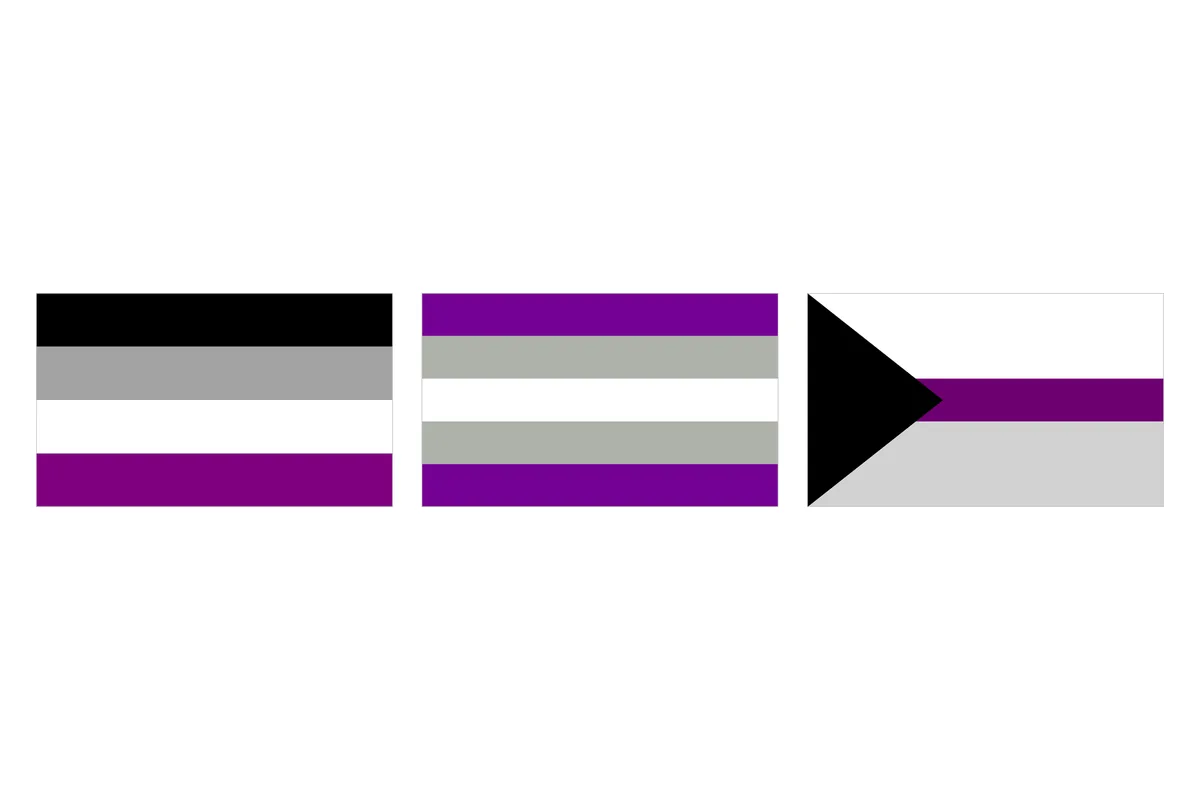
Two labels come up most often:
- Grey-asexual (grey-ace or grey-A): sexual attraction that is rare, faint or only happens in specific circumstances. UNC’s LGBTQ Center describes it as falling somewhere between asexuality and sexuality.
- Demisexual: sexual attraction that only appears after a strong emotional connection has formed. Our guide to what demisexuality means covers it in depth.
These are not rare side labels. In The Trevor Project’s youth survey, 15 percent of ace respondents also chose demisexual and 9 percent chose greysexual.
The ace community grew up online in the early 2000s. Most of the finer labels are defined by how community members use them, and research has looked at few of them. They work as tools for describing an experience, not as boxes anyone has to pass a test to enter. The full set, from aceflux to aegosexual, is laid out in our guide to asexual spectrum labels.
Romantic orientation, dating and relationships
Many ace people date and fall in love. Feeling no sexual attraction says nothing about whether someone falls in love, and plenty of ace people date, marry or build long-term partnerships.
Romantic attraction runs on its own track
Ace communities often use the split attraction model, which treats sexual attraction and romantic attraction as two separate things. Under that model, an asexual person who wants romantic relationships with people of another gender might call themselves a heteroromantic asexual person. Others use homoromantic, biromantic or panromantic in the same way.
Some ace people are also aromantic, meaning they feel little or no romantic attraction, but many are not. In The Trevor Project’s youth survey, ace respondents chose panromantic (20 percent), biromantic (17 percent) and aromantic (13 percent) as extra labels. Our guide to romantic orientation explains each of these, and sexual attraction vs romantic attraction shows how to tell the feelings apart.
What ace relationships can look like
The numbers suggest relationships are ordinary for ace people. The Williams Institute study only covered ace people who also identify as LGB. Of those, 59 percent were in a romantic relationship, close to the 61 percent of non-asexual LGB people.

An ace person’s partner is often not ace. AVEN notes that the ace dating pool is very small, so many asexual people end up in mixed relationships with sexual partners. These often need compromise. Take a hypothetical couple: one partner is ace and sex-indifferent, the other wants sex regularly. They might agree on how often, what kinds of touch feel good to both, and what happens when one of them is not in the mood. The Trevor Project stresses honest talk about boundaries and regular check-ins, because comfort can change over time.
Other ace people choose close friendships or queerplatonic partnerships, which are committed and deeply emotional but not romantic. Some are happiest single. None of these is a lesser outcome.
How people come to identify as ace
Most people arrive at the label slowly, by noticing a pattern and then finding a word that fits it. There is no test, and the decision belongs to the person using the word.
There is no test, only patterns you notice
No test can determine whether someone is ace, as AVEN says plainly. A research tool called the Asexual Identification Scale exists, but it was built for studies. If the word helps you describe yourself, you can use it, and if that changes later, that is fine too.

The patterns people describe are often social. Mental Health America notes that in the teen years and early adulthood, it can feel as if sex is all your peers talk about. Some ace people fake their way through those conversations to fit in. Others realise they never understood what friends meant by a crush that was “about” sex. A few first assume they are late bloomers, or that the right person will come along. HRC notes that ace people are often told exactly that, or told it is a phase.
One experience does not settle it either way. The Trevor Project answers a reader whose first kiss felt gross by saying this does not necessarily mean they are ace. It adds that whether a label fits is up to you, and you do not need one until you are ready.
Finding other ace people
Talking to people with similar experiences is often what makes the label click. AVEN hosts the world’s largest online asexual community, and it welcomes people who are still questioning. The Trevor Project points ace young people to AVEN and offers its own round-the-clock support for LGBTQ+ youth.
Mental Health America suggests community events, dating apps and online groups as ways to meet other ace and LGBTQ+ people. If you would like a professional to talk things through with, Healthline recommends an LGBTQIA+ affirming therapist.
Frequently asked questions about asexuality
What are some signs of being asexual?
There are no outward signs, and nothing about how someone looks or acts marks them as ace. The usual clue is internal: you rarely or never look at a person and want sex with them, even when friends describe feeling that way. AVEN stresses that there is no test, so the label is yours to try on and keep or drop.
Can asexual people still kiss?
They can, if they want to. AVEN describes sensual attraction as a wish for touch such as cuddling, hugging or kissing, without that touch being sexual. An ace person may kiss a partner as a sign of romance or affection. Others dislike kissing, and that is just as valid. Preferences differ from person to person, as they do for anyone.
Can asexual people change?
Most ace people have been asexual their whole lives, according to AVEN, though some only use the label for a short time while questioning. Healthline notes that some people find their capacity for attraction shifts over time. A shift does not mean someone was wrong before. Nobody should be pushed into sex in the hope of changing them, either.
Why am I asexual?
There is no known cause, and you do not need one. Asexuality is an orientation, not a symptom, so it should not be put down to trauma, a hormone problem or an illness. A change in desire that worries you, such as after a new medicine, an illness or a hard experience, is a separate health question worth raising with a doctor. Bogaert’s 2004 data linked asexuality with factors such as gender and health, but these were statistical associations, not explanations for any one person. Being ace is simply one way human sexuality varies.
Is asexual part of LGBTQ+?
Yes, for ace people who want to claim it. Mental Health America calls ace and ace-spectrum people valid members of the LGBTQ+ community. Williams Institute author Ilan Meyer also described asexuals as an integral part of the LGBT community. Still, The Trevor Project notes that not everyone who is asexual wishes to be part of it, and that choice is personal.
Where to go from here
So what does it mean to be asexual? It means feeling little or no sexual attraction to other people. A sex drive, a relationship or a sex life can sit alongside that, or not, and none of those choices makes someone more or less ace.
The label is a tool. Use it if it helps you describe yourself, and set it down if it stops fitting. If you want to go further, start with the asexual spectrum labels guide or the page on demisexuality. If romance is the open question, the guide to romantic orientation is the next stop. The AVEN forums and The Trevor Project are good places to hear from ace people directly.
This article is general education, not medical advice. If a change in desire is upsetting you, talk to an affirming clinician.
Related reading
- The Asexual Spectrum: Ace Labels Sorted by What They Describe
- Demisexual Meaning: Attraction That Grows From an Emotional Bond
- Romantic Orientation Explained: Biromantic, Panromantic and More
Sources
- What does it mean to be asexual? - The Conversation
- Overview - The Asexual Visibility and Education Network (AVEN)
- What Does Being Asexual Mean? - Healthline
- Asexuality (Five things to know about) - CMAJ (Canadian Medical Association Journal)
- Understanding Asexuality: FAQs & Supportive Resources - The Trevor Project
- Asexuality, Attraction, and Romantic Orientation - LGBTQ Center, University of North Carolina at Chapel Hill
- Asexuality: prevalence and associated factors in a national probability sample (abstract) - Journal of Sex Research (Bogaert, 2004), via PubMed
- Journal Club: Why is absent/low sexual desire a mental disorder? - The Asexual Agenda
- 1.7% of sexual minority adults identify as asexual - Williams Institute, UCLA School of Law
- Asexual and Ace Spectrum Youth - The Trevor Project (research brief)
- Asexuality: an extreme variant of sexual desire disorder? (abstract) - The Journal of Sexual Medicine (Brotto, Yule and Gorzalka, 2015), via PubMed
- Asexuality: Sexual Orientation, Paraphilia, Sexual Dysfunction, or None of the Above? (abstract) - Archives of Sexual Behavior (Brotto and Yule, 2017), via PubMed
- Asexuality and mental health - Mental Health America
- Understanding the Asexual Community - Human Rights Campaign
- Asexuality Is Finally Breaking Free from Medical Stigma - Scientific American